Bed bug treatment in Singapore
Bed bugs aren't a sign of a dirty home. They travel in luggage, bags and second-hand furniture, hide in the seams of mattresses, bed frames and sofas, and come out at night to feed. They're hard to clear with home remedies because they hide so well, and because their eggs survive treatments that kill the adults.
Tell us what you've found and we'll pass it to a partner pest-control firm, which inspects, confirms whether it's bed bugs, and quotes the treatment.
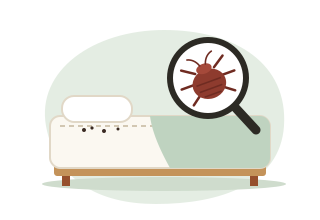
What a bed bug problem looks like
- Itchy bites in lines or clusters, often on the arms, neck and shoulders, that appear after sleeping. Bites alone don't prove it's bed bugs: people react differently, and other insects bite too.
- Small dark spots, like dots from a marker pen, on mattress seams, sheets and the bed frame. These are droppings.
- Tiny smears of blood on sheets or pillowcases.
- Live bugs: flat, oval, reddish-brown and about the size of an apple seed, in mattress seams, bed-frame joints, headboards and sofa cushions.
- Pale shed skins and tiny white eggs in the same hiding places.
- A sweet, musty smell in badly affected rooms.
Check the seams and corners of the mattress, the joints of the bed frame and behind the headboard with a torch. If you catch one, stick it to a piece of tape or seal it in a bag so the firm can identify it.
Treatment options for bed bugs
The partner firm recommends a treatment after seeing the property. These are the methods it's likely to talk you through.
Inspection
The firm checks beds, sofas, bedside furniture, curtains and nearby cracks to confirm it's bed bugs and to find out how many rooms are affected. Treating only the bed often isn't enough.
Residual insecticide treatment
Insecticide is applied to seams, frames, joints, skirting and the cracks where bed bugs hide. Because eggs aren't reliably killed, a second treatment is commonly booked about two weeks later to catch the newly hatched bugs.
Steam treatment
High-temperature steam on mattresses, sofas and fabrics kills bed bugs and their eggs on contact, without chemicals. It's often combined with insecticide for hiding places steam can't reach.
Mattress encasements
Sealed covers trap any bed bugs left inside a mattress and make new ones easy to spot. They support treatment; they don't replace it.
Removing badly infested items
Sometimes the practical answer is to get rid of a heavily infested mattress or sofa. It needs to be wrapped and sealed before it's moved, so it doesn't drop bugs on the way out.
Ask how many visits are included, what you need to do between them, and whether a final inspection is part of the quote.
If the firm advises getting rid of a mattress or sofa, wrap and seal it first. Junk to Clear, a disposal company we refer jobs to, can collect it.
What affects the price
We don't publish prices. The partner firm gives you a price after an inspection, or from what you tell it when the job is simple. These are the things it will ask about.
- How many rooms are affected, and how many beds, sofas and other pieces of furniture need treating.
- How long the problem has been going on, which affects how far the bugs have spread.
- The method: insecticide, steam, or both.
- The number of visits. Bed bug treatment is usually more than one.
- Clutter around beds and sofas, which adds hiding places and time.
- For offices, the number of workstations, meeting rooms and upholstered chairs involved.
Comparing quotes
When you compare prices, compare what's included: the number of visits, whether follow-ups are in the price, what's treated, and what happens if the problem comes back.
How to prepare, and what happens on the day
Before the visit
- Follow the firm's preparation list closely. Bed bug treatment depends on it more than most pest treatments do.
- Wash bedding, curtains and clothes from the affected rooms on a hot cycle and tumble-dry them on high heat, then keep them in sealed bags until after treatment.
- Clear the floor and the space under the bed, and empty bedside drawers, so the firm can reach every hiding place.
- Don't move furniture, bedding or belongings out of affected rooms into other rooms. That's how bed bugs spread through a home.
- Don't use your own sprays or foggers beforehand. They can drive bed bugs into walls and other rooms.
- Don't throw out a mattress or sofa until the firm has seen it. It may be treatable, and if it isn't, it needs wrapping before it's moved.
On the day
- 1 The firm inspects beds, sofas and nearby furniture, and confirms which rooms need treating.
- 2 Mattresses, frames, sofas, skirting and cracks are treated with insecticide, steam, or both.
- 3 You'll be asked to keep out of treated rooms for a few hours, or as long as the firm advises, and to let surfaces dry before using them.
- 4 Before leaving, the firm books the follow-up visit and tells you what to do in the meantime.
Afterwards
Keep sleeping in your own bed after treatment; moving to another room can lead the bugs there. Vacuum around the bed often, keep bags and luggage off the bed, and check luggage and second-hand furniture after you bring them home. Report any new bites or signs before the follow-up visit.
Bed bugs in homes and offices
The same pest is a different job in a flat, a landed house or an office. Here's what changes.
HDB flats
In HDB flats, bed bugs usually arrive in luggage, second-hand furniture or with visitors, and in a compact layout they spread between rooms quickly. Treatment usually covers every bedroom and the living-room sofa, not only the room where the bites started.
Condos
In a condo, it's usually a treatment for your own unit. If you let the unit out, or a tenant has just moved in or out, deal with it before the next person moves in: bed bugs can survive a long time in an empty unit.
Landed homes
Landed homes have more bedrooms and usually more furniture, so it's important to inspect every room where people sleep or sit. Check the helper's room, guest rooms and rooms that are rarely used, too.
Offices
Bed bugs in offices usually arrive in bags and clothing, and hide in upholstered chairs, breakout sofas and around workstations. The firm can treat out of hours or over a weekend. It also helps to tell staff what to check at home, so the problem doesn't keep coming back.
Pest control and NEA licensing
In Singapore, companies that do vector control work, which covers pests such as mosquitoes, rats and cockroaches, must be registered with the National Environment Agency (NEA) as Vector Control Operators. The people doing the work must hold NEA licences or certificates. Before work starts, you can ask the firm for its registration details and check them against NEA's list of registered operators.
Questions about bed bugs
How many treatments do bed bugs need?
Usually more than one. Insecticides don't reliably kill eggs, so a follow-up visit is commonly booked to catch bed bugs that hatch after the first treatment. The firm will confirm the number of visits in its quote.
Do I need to throw out my mattress?
Not always. Many mattresses can be treated and then sealed in an encasement. If one is too badly infested, the firm will say so, and it should be wrapped and sealed before it leaves the room.
Can bed bugs spread to my neighbours?
They can, especially in flats, through gaps around pipes and wiring and on people's belongings. That's another reason not to put off treatment.
Ask for a bed bug treatment quote
Tell us the pest, the property and roughly where it is. It takes a minute, and there's no obligation to book.
Thank you. Your enquiry is on its way.
We usually reply within one working day. We'll pass your enquiry to a partner pest-control firm, which will contact you to arrange an inspection or give you a quote.
There's nothing else you need to do. If you left something out, send another enquiry.