Termite control in Singapore
Termites do their damage out of sight, inside door frames, skirting, built-in wardrobes and flooring, so by the time you notice them the colony is often well established. They're one pest where waiting to see whether it goes away usually makes the job bigger.
Tell us what you've found and we'll pass it to a partner pest-control firm. The firm inspects, works out which kind of termite it is and how far it has spread, and quotes the treatment.
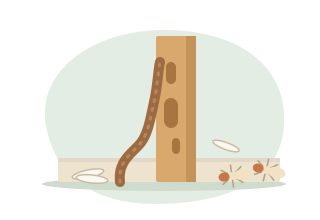
What a termite problem looks like
- Mud tubes: thin tunnels of soil running up walls, along skirting, or from the floor into door frames and cabinets. Subterranean termites build them to travel between the soil and the wood they're eating.
- Wood that sounds hollow when tapped, or crumbles or gives when pressed, especially door frames, skirting and the base of built-in wardrobes.
- Bubbling or blistered paint, or wallpaper that ripples, where termites are feeding behind it.
- Swarms of winged insects indoors, often around lights in the evening, followed by little piles of shed wings on windowsills and floors.
- Small heaps of tiny pellets, like fine sand, below wooden furniture or frames. This points to drywood termites, which live inside the wood itself.
- Doors or drawers that suddenly start to stick because the frame has been weakened.
Flying ants swarm too. Termites have straight antennae, a thick waist and two pairs of wings of equal length; flying ants have bent antennae and a pinched waist. A photo helps the firm tell them apart.
Treatment options for termites
The partner firm recommends a treatment after seeing the property. These are the methods it's likely to talk you through.
Inspection
Every termite job starts here: finding where they are, how they're getting in, and whether they're subterranean termites coming from the soil or drywood termites living in the wood. The treatment depends on the answer.
Baiting systems
Bait stations go onto active mud tubes indoors, or into the ground around a landed property. Termites feed on the bait and carry it back to the colony, which is gradually wiped out. It works slowly, with regular checks over weeks or months, but it aims at the colony rather than only the termites you can see.
Liquid soil treatment
A termiticide is applied to the soil around and under a building, creating a treated zone termites can't cross. It's mainly used for landed homes and ground-floor premises, and sometimes means drilling small holes through the floor slab to reach the soil beneath.
Direct wood treatment
Termiticide foam, dust or liquid is injected into infested frames and furniture. It's the usual method for drywood termites and for localised activity, often alongside baiting.
Pre-construction and renovation treatment
Soil treatment before a new slab is laid, or treatment of timber during a renovation, protects the building from the start. It's worth asking about before any major works on a landed home.
Termite work often comes as a programme of visits rather than a single treatment. Ask what happens if activity returns, whether there's a warranty and how long it lasts, and which inspections are included.
What affects the price
We don't publish prices. The partner firm gives you a price after an inspection, or from what you tell it when the job is simple. These are the things it will ask about.
- Whether they're subterranean or drywood termites, which decides the method.
- How far the activity has spread: one door frame, or several rooms and built-in carpentry.
- The method. Baiting runs over several visits, while soil treatment depends on the building's footprint and whether drilling is needed.
- The size and type of property. A landed house with a garden is treated very differently from a flat on a high floor.
- How long any monitoring or warranty period runs, and how many inspections it includes.
- Whether damaged wood needs replacing. That's carpentry, usually quoted separately.
Comparing quotes
When you compare prices, compare what's included: the number of visits, whether follow-ups are in the price, what's treated, and what happens if the problem comes back.
How to prepare, and what happens on the day
Before the visit
- Leave mud tubes and damaged wood as they are. Breaking them open or spraying them can drive termites into another part of the home.
- Clear access to the affected areas: the inside of built-in wardrobes, the space under kitchen cabinets and the skirting behind furniture.
- Note every spot where you've seen signs, including the ones that seem minor.
- For landed homes, make sure the firm can reach the outside walls, garden beds and any timber in the garden.
- If you're renovating, tell the firm and your contractor before damaged carpentry is torn out.
On the day
- 1 The firm inspects the affected areas and the rest of the property, looking for mud tubes, damaged wood and the likely way in.
- 2 It confirms the type of termite and recommends a method.
- 3 For baiting, stations are fitted over active areas and dates are set to check and refill them.
- 4 For soil treatment, the firm works around the building and, where needed, drills and injects through the floor slab, then patches the holes.
- 5 Before leaving, it tells you what to leave alone and which signs to report between visits.
Afterwards
Don't move bait stations or clear away mud tubes the firm has baited. Cut down what attracts termites: fix leaks, keep timber and cardboard off damp floors, and in landed homes keep soil and garden mulch away from wooden structures.
Termites in homes and offices
The same pest is a different job in a flat, a landed house or an office. Here's what changes.
HDB flats
HDB flats get termites too, including on high floors, where they can come in through cracks, service ducts and wooden fittings brought in from outside. Activity usually shows up in door frames, skirting and built-in carpentry. Baiting and direct treatment are the usual methods, because soil treatment isn't practical above the ground floor.
Condos
In a condo, termites inside your unit are yours to treat, but if the activity seems to be coming from the structure, the landscaping or several units, tell the managing agent. The management corporation may need to treat the common property, and treating only your unit won't stop them coming back.
Landed homes
Landed homes are the most exposed: the house sits on soil and often has a garden, timber decking and older wooden fittings. Firms commonly propose soil treatment or ground baiting around the house, together with a programme of inspections.
Offices
In offices, termites tend to turn up in carpentry, raised flooring, partition walls and document storage. The firm can usually work out of hours. If you lease the space, tell building management, because the source may be in the structure or in another tenant's unit.
Pest control and NEA licensing
In Singapore, companies that do vector control work, which covers pests such as mosquitoes, rats and cockroaches, must be registered with the National Environment Agency (NEA) as Vector Control Operators. The people doing the work must hold NEA licences or certificates. Before work starts, you can ask the firm for its registration details and check them against NEA's list of registered operators.
Questions about termites
Can I get rid of termites myself?
Spraying the termites you can see kills only those termites, and often drives the rest of the colony into another part of the home. Professional treatment aims to reach the colony itself, which is why an inspection comes first.
How long does termite treatment take?
It depends on the method. Direct treatment and soil treatment are done in one visit or a few, while baiting works gradually and is checked over a series of visits until the activity stops. The firm will set out its schedule in the quote.
Do flying termites mean I have an infestation?
A few winged termites near a light can come in from outside. Swarms indoors, or shed wings piling up on windowsills, suggest a colony may be close by, and that's worth an inspection.
Ask for a termite control quote
Tell us the pest, the property and roughly where it is. It takes a minute, and there's no obligation to book.
Thank you. Your enquiry is on its way.
We usually reply within one working day. We'll pass your enquiry to a partner pest-control firm, which will contact you to arrange an inspection or give you a quote.
There's nothing else you need to do. If you left something out, send another enquiry.